
 EN
EN


What to Consider When Choosing a Plastic Molding Manufacturer
Choose POLYWELL for high-quality plastic molding solutions, advanced technology, and customer-driven service in the construction industry
View More
Guide rail support refers to the structural components and mounting system that provide a stable, rigid, and precisely aligned foundation for linear guide rails. The performance and accuracy of the entire linear motion system are entirely dependent on the integrity of this support structure. A guide rail must be mounted to a surface that is flat, straight, and possesses sufficient rigidity to resist deflection under the maximum operating loads, including the combined forces of the moving carriage, the workpiece, and acceleration/deceleration. Any deviation in the mounting surface, such as warping, twisting, or insufficient stiffness, will be transmitted to the rail, causing binding, premature wear, and a loss of positioning precision. Guide rails are typically secured using counterbored screws tightened to a specified torque to ensure even clamping force along their entire length. For very long travel lengths, rails are often butt-joined using alignment pins and precisely machined ends to create a continuous, seamless running surface. The support structure itself, usually a massive weldment or cast iron base, is often stress-relieved before final machining to ensure long-term dimensional stability. In high-precision applications, the mounting surface is ground or scraped to achieve the required flatness and straightness tolerances. Proper guide rail support is not an afterthought but a foundational engineering principle that guarantees the designed performance, lifespan, and reliability of automation equipment, from the haul-off units in an extrusion line to the cutting saws that depend on repeatable, accurate linear movement.
22
Nov
28
Mar
28
Mar
28
Mar
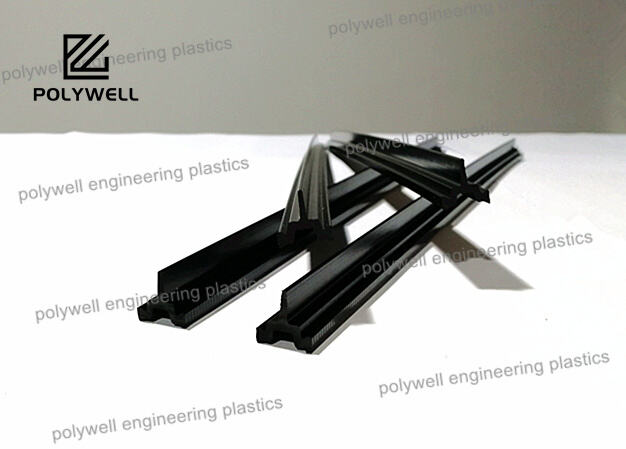

POLYWELL specializes in PA66 thermal insulation strips, offering polyamide granules, extruders, molds, winding machines, and comprehensive one-stop customization services.
Jinfeng Town, Zhangjiagang City, Suzhou City, Jiangsu Province, China
Copyright © 2024 Suzhou Polywell Engineering Plastics Co.,Ltd Privacy Policy